
How to Use the SKF Online Calculation Service For Bearing Lifetime Evaluation with AVL EXCITE™ M
Published on March 10, 2026 · 9 min read

How Do Bearings Fail
Bearing failure remains one of the most common issues in automotive transmissions – particularly in EDUs, where high rotor speeds and significant output loads accelerate fatigue. The dominant long‑term mechanism is Rolling‑Contact Fatigue. Repeated over‑rolling generates alternating subsurface shear stresses, initiating micro‑cracks below the surface. These cracks propagate until they break through, forming pits. Clusters of pits evolve into spalls, removing material, degrading performance, and ultimately leading to failure.
Real‑world bearing life is influenced by load, geometry, lubrication, contamination, and lubricant aging.
How Can We Predict It?
The traditional measure is L10 life - the time by which 10% of identical bearings are expected to fail under specified conditions. ISO 281:2007 calculates L10 using the Lundberg–Palmgren method, based solely on equivalent loads and speed:
L₁₀ = (C / P)ᵖ
where C = basic dynamic load rating (kN); P = equivalent dynamic bearing load (kN); p = exponent (3 for ball bearings, 10/3 for roller bearings)
While useful, this approach does not account for lubricant quality, contamination, or fatigue‑load limits. SKF therefore extends this with their own life modification factors [1]:
a₁ - reliability adjustment factor
aₛₖₓ - SKF life modification factor, incorporating lubrication regime, contamination, and Explorer‑bearing performance
Lₙₘ = a₁ · aₛₖ𝒻 · (C / P)ᵖ
SKF also developed the SKF Generalized Bearing Life Model (GBLM). This separates surface (1) and subsurface failure modes (2) (see Figure 1). The model evaluates surface fatigue with advanced tribological models and subsurface fatigue with a classical Hertzian rolling contact model. It includes the effects of lubrication, contamination, and raceway surface properties, which influence the stress distribution in the rolling contact area. The SKF GBLM is available for bearings with special features, such as hybrid ceramic bearings.
Lₙₘᴳᴹ = a₁ · [ 1 / L₁₀,surfᵐ + 1 / L₁₀,subᵐ ]⁻¹
![Figure 1: Surface and Sub-Surface Failure Regions in SKF GBLM Method [2]](/sites/default/files/styles/original_small/public/2026-02/figure1.png.webp?itok=fDl6DUqA)
SKF have decades of endurance test data to validate these approaches; something that you can now take advantage of by interfacing with their online calculation services directly within the Bearing Lifetime Calculation app.
Bearing Lifetime Calculation App
The Bearing Lifetime Calculation COMPOSE app can be launched from the AVL EXCITE™ M App Library or directly in COMPOSE under EXCITE M Apps (see Figure 2). To use the SKF Calculation Service, users need:
- Valid SKF account (click "Validate Credentials" to establish a connection).
- Bearings with valid SKF designations.
- Simulation results for the cases of interest.
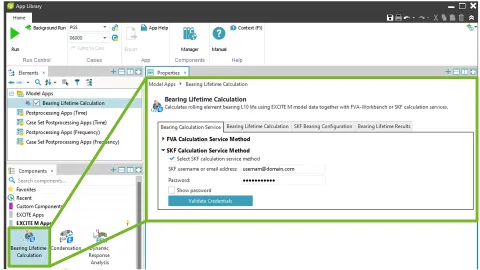
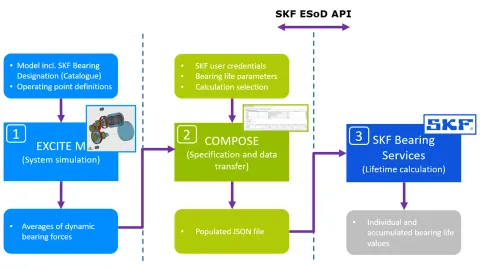
The app acts as a central hub: It collects EXCITE M simulation data, applies user‑defined parameters, and performs lifetime calculations using either FVA‑Workbench or (as of this latest enhancement) the SKF Calculation Service. A workflow for the SKF service is shown in Figure 3.
Bearing and Calculation Type Selection
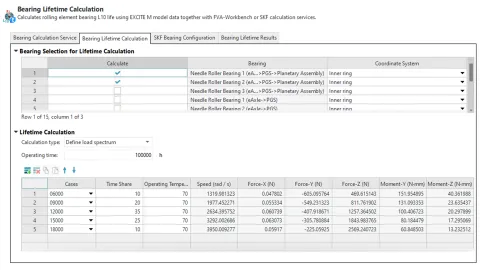
Upon opening the app, all roller bearings in the model appear in the Bearing Lifetime Calculation tab. Users select the bearings and EXCITE M cases they wish to evaluate. A preview of speed and load components (averaged across the result storage interval) is shown for each highlighted bearing, helping identify critical operating points (see Figure 4).
The Lifetime Calculation section offers two calculation modes:
- Individual:
Each case is treated as if its load and speed occur for 100% of the bearing’s operating time. A separate lifetime result is generated for each case. - Load Spectrum (Accumulated):
Multiple operating points are combined into a single lifetime result. Users assign time shares (hours, percentages, or factors) to represent real service‑life distribution.
SKF Bearing Configuration
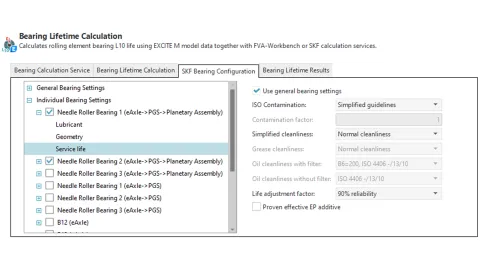
The SKF Bearing Configuration tab (see Figure 5) allows users to define:
- Geometry: Imported from the active EXCITE M case (SKF designation required). Clearance class can be specified here.
- Lubricant: Rheological and operational properties, either globally or per bearing.
- Service life parameters: Contamination levels, cleanliness guidelines, and life adjustment factors.
Users of the SKF Product Select tools will already be familiar with these inputs.
Calculation and Results
After selecting bearings, cases, and parameters, simply press Run. The app will connect with the SKF Calculation Service via the SKF ESoD API (SKF Engineering Service on Demand), and provides results within seconds.
The app outputs the following to the Bearing Lifetime Results tab (see Figure 6):
- ISO 281:2007 nominal rating life (hours).
- SKF Rating Life (hours) (using either SKF Rating Life approach or SKF GBLM for bearings that require it).
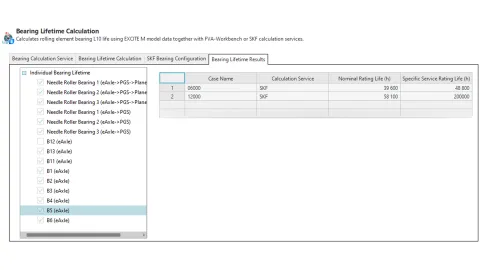
Lifetime results for individual cases can also be accessed directly in AVL IMPRESS™ M. To view them:
- Open the Data Browser and navigate to: Project → Model → Case set → Case.
- In the result hierarchy for the selected case, choose the relevant bearing.
- If a lifetime calculation was performed, a Lifetime Results folder will appear under Dynamics – Time Solution.
- Select Summary from the available result quantities to display the results in a table.
SKF Bearing Catalogue
Take advantage of the SKF catalogue in the bearing geometry editors. Simply select the Source as Bearing Catalogue | SKF. Then, either utilize the bearing dropdown menu and search functionality, or the Bearing Catalogue Browser (see Figure 7). The browser supports filtering by boundary dimensions and can suggest filters based on the link location geometry.

With this update in the EXCITE M 2025 R2 release, you now have a powerful and reliable way to evaluate bearing life directly within your workflow. By connecting the Bearing Lifetime Calculation app to the SKF Calculation Service, you can combine your simulation results with SKF’s validated life models and expertise - giving you confidence that your predictions reflect real‑world operating conditions. With direct access to the SKF Bearing Catalogue in EXCITE M, configuring SKF bearings and predicting their service life has never been easier!
References
- SKF Group, “Bearing rating life,” SKF Rolling Bearings – Principles of Bearing Selection. [Online]. Available: https://www.skf.com/group/products/rolling-bearings/principles-of-rolling-bearing-selection/bearing-selection-process/bearing-size/size-selection-based-on-rating-life/bearing-rating-life
- SKF Group, Generalized Bearing Life Model (GBLM). Evolution Online, 2015. [Online]. Available: https://evolution.skf.com/wp-content/uploads/2015/09/SKF_Generalized_Bearing_Life_Model_EN_evo415.pdf
Stay tuned
Don't miss the Simulation blog series. Sign up today and stay informed!
Read More About This Topic

NVH analysis is typically performed after a problem has been identified that needs to be addressed. In the case of a simulation model used, it is advisable to proactively look for increased vibration and resonance so that the model can be optimized before the first prototype is built.

Discover how AVL EXCITE™ M’s new dynamic roughness adjustment method enhances the realism of bearing wear simulations, leading to smarter engine designs and longer component life.
At the upcoming AVL SIMpulse we open the black box of bearing behavior inside the e-motor.
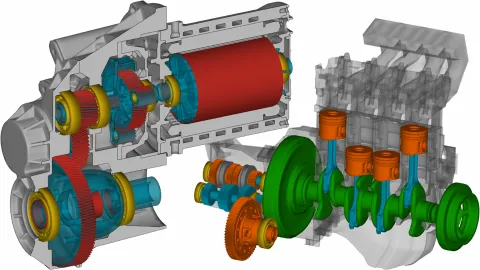
As a multibody dynamics software, AVL EXCITE™ M gives engineers the tools to analyze powertrains early in development, covering NVH analysis, durability assessments, and detailed modal analysis.
Stay tuned for the Simulation Blog
Don't miss the Simulation blog series. Sign up today and stay informed!