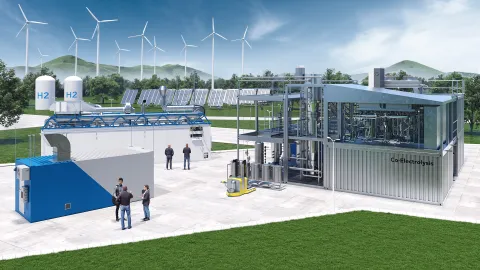
Optimizing the performance, cost and lifespan of industrial energy systems and related components is central to scaling the transition to carbon neutrality.
As technologies expand to meet global demand, engineering teams face increasing pressure to optimize components and systems as well as operating strategies under tight timelines.
Therefore, high‑fidelity multi-physics models, capturing electrochemistry, fluid dynamics, mechanical and thermal behavior as well as the related simulation tools and methods are required to enable engineers to efficiently explore design variations of individual components and entire systems and plants.
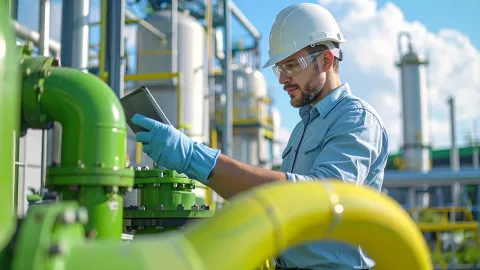
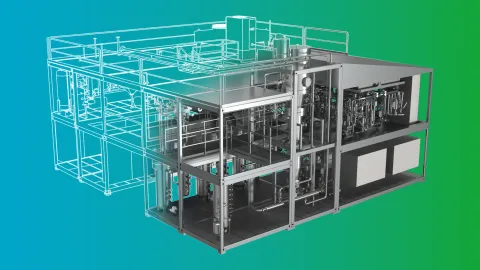
Our scalable simulation software enable engineers to choose between detailed 3D multi-physics and fast 0D/1D system simulation, depending on the stage of development and the level of fidelity required. This flexibility allows complex local phenomena, such as flow distribution, mechanical contact forces, heat transfer, or electrochemical reactions, to be analyzed in 3D and then translated into reduced‑order models for system integration.
Consistent parameterization and shared data structures ensure that insights gained at one scale can be reused without manual rework. The application of such tools and methods accelerates design cycles, supports rapid iteration, and maintains accuracy across all levels of modeling.
Understanding multi‑physics interactions in e.g. electrolyzers, fuel cells, wind-turbines, battery storage systems and chemical reactors is essential because electrochemistry, heat transfer, fluid flow, and material behavior are tightly coupled. Detailed analysis of these interactions reveals how small changes in one domain can cascade into performance losses or accelerated degradation and damage.
Our simulation tools and methods help uncover these cross‑effects, enabling engineers to design systems that operate within optimal, stable regimes. Mastering these multi‑physics relationships is a foundational step toward achieving the highest efficiency and long operational lifetimes.
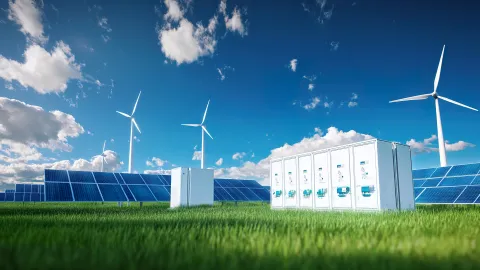

Scalable multiphysics simulation accelerates virtual prototyping by allowing engineers to analyze detailed local phenomena and full system behavior early in development. This reduces the need for iterative physical testing, enabling faster design cycles and more informed decision‑making.
Virtual validation enables components and entire systems, such as electrolyzers, wind-turbines and stationary battery storage systems as well as their integration with balance-of-plant, thermal management and grid systems, to be tested across a wide range of operating conditions long before physical prototypes are available.
By integrating virtual testing with hardware‑in‑the‑loop methods, developers can refine control strategies and system responses under realistic conditions without need for real hardware.
As a result, industrial energy component and system development progresses more efficiently, with higher confidence in performance and durability.

Virtual system layout and component design in the early development phase is vital to reduce costs, risks and to accelerate innovation.
AVL’s scalable multi-physics simulation tools and methods allow engineers to efficiently model complex processes, validate performance virtually, and refine systems before physical prototyping.
- Reinhard Tatschl, Principal Research & Development Manager
AVL CRUISE™ M Multi-domain System Simulation Platform
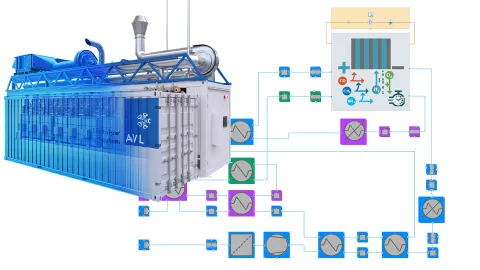
The AVL CRUISE™ M multi-domain system simulation platform is designed to support a model-based approach to system development. It seamlessly integrates high-fidelity, real-time subsystem models of electrical, thermal, fluid flow, and control networks.
System simulation adopting CRUISE M fosters innovation by providing a virtual environment for testing new ideas and concepts. Researchers and engineers can experiment with different designs, materials, and operating conditions without the constraints of physical prototypes. This accelerates the development cycle and allows for rapid iteration and improvement, driving technological advancements in the field.
- Low- and high-temperature electrolyzer and fuel cell system layout, component technology selection and sizing
- Electrolyzer and fuel cell system performance, cost and lifetime optimization
- Co-electrolysis, direct-air-capturing, e-fuel and ammonia synthesis system operation strategy definition
- Stationary battery storage system layout and ageing/degradation quantification
AVL FIRE™ M Multiphysics 3D-CFD Simulation Environment
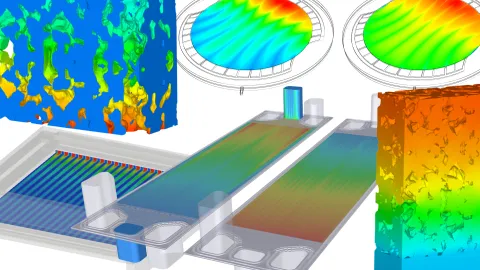
The multi-physics CFD simulation platform AVL FIRE™ M provides detailed insights into industrial energy systems related components’ internal fluid flow, thermal and electrochemical conversion processes that are difficult or impossible to measure experimentally.
Optimizing plant components, such as electrolyzer and fuel cell stacks, stationary battery storage modules, chemical reactors, catalytic converters, heat exchangers, etc., for best performance and lifespan demands a holistic and multi-scale simulation approach.
In this respect FIRE M offers high-resolution, physics-based simulation capabilities that provide deep insights into the internal dynamics of the various system components adopted in industrial energy applications. It enables detailed visualization and analysis of fluid flow, heat transfer, and electrochemical phenomena that are extremely difficult or even impossible to measure directly experimentally.
- Low-temperature electrolyzer (PEM, AEM, Alkaline) and PEM fuel cell stack performance, cost and lifespan optimization
- High-temperature solid-oxide electrolyzer and fuel cell stack design and module gas media supply and thermal management optimization
- Balance-of-Plant components design and performance optimization
- Stationary battery storage safety assessment and thermal propagation mitigation strategy definition
AVL EXCITE™ M Multibody Dynamics Simulation
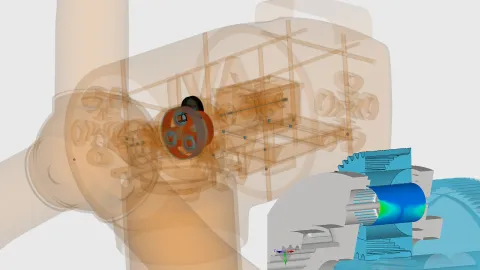
AVL EXCITE™ M is a multi-body dynamic simulation software that enables engineers to create high‑fidelity virtual twins of energy conversion machinery, such as wind turbines or IC‑engine‑driven generators. High fidelity is achieved through time‑domain simulation, which accurately captures nonlinear system behaviour, and by incorporating detailed physics of key interactions such as gear and roller‑bearing contacts, hydrodynamic lubrication in slider bearings, and electro‑mechanical coupling in e‑motors and generators.
With results from EXCITE M, engineers can identify potential issues early in the development process, including bearing failures, component durability risks, and noise or vibration concerns. By enabling earlier insights, the multibody dynamics software helps streamline development workflows and ensures that products meet durability, noise, and vibration targets before hardware is built.
- Design proper bearing profiles in the wind turbine transmission oil film bearings
- Evaluate vibration interaction between the combustion engine and the generator
- Optimize gears micro geometry in industrial transmissions
- Obtain boundary conditions for stress evaluation in any energy conversion machinery component
We are your global partner in realizing the renewable energy expansion. We offer simulation solutions ranging from component to system analysis, wherever you are located. Our software solutions, tools and projects are deeply integrated in the development process and enable you to master the challenges of virtualization.

75+
years of experience
in 26
countries worldwide
12,200
employees worldwide
65%
engineers and scientists
AVL White Paper – Accelerate Fuel Cell Innovation
AVL’s scalable simulation solutions help you design and optimize fuel cells and stacks and their supporting systems, and to make the best integration decisions.
AVL White Paper – Electrolyzer Simulation Performance and Lifetime
Discover how simulation enhances electrolyzer development by boosting efficiency, durability, and integration with renewable energy sources.
AVL White Paper – Industrial Energy - Virtual System Layout and Component Design
Achieving carbon neutrality across global industries requires a fundamental shift in how energy is produced, stored, and consumed. Green hydrogen, i.e. hydrogen generated through electrolysis powered by renewable energy, has emerged as a cornerstone of this transition.