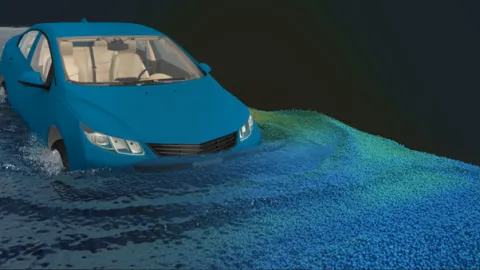
Vehicle development teams need to understand complex fluid behavior earlier, faster, and with greater confidence. Whether the challenge is water wading, vehicle soiling, gearbox lubrication, e-drive cooling, snow applications, or multiphase flows, physical testing alone is often too late, too expensive, and too limited for today’s development timelines. PreonLab helps engineers replace late-stage testing with earlier virtual insight. Its particle-based CFD approach makes it possible to simulate dynamic free-surface flows, moving geometries, splashing, wetting, and fluid interaction without the traditional meshing effort of classic CFD.
The result is a faster and more practical way to evaluate design variants, reduce prototype dependency, and make better engineering decisions — using either existing on-site hardware or cloud-based simulation resources.
Industry-Proven
PreonLab is trusted by more than 130 customers worldwide across the automotive, aerospace, and environmental industries. It is used in demanding engineering and product development processes where accurate prediction of complex fluid behaviour is critical to performance, reliability, and safety.
Validated Results
PreonLab models are validated against a wide range of industrial and academic benchmarks and supported by numerous customer reference projects. Combined with tested workflows and extensive real-world application experience, this validation foundation helps engineers make confident, simulation-based design decisions.
Easy to Use
With an intuitive interface, streamlined setup, and clear result visualization, PreonLab makes advanced particle-based CFD accessible for simulation specialists and design engineers. With its mesh-free approach, multi-hardware support, and Python-based API, PreonLab offers users remarkable control over their simulation workflow.
Computational Efficiency
PreonLab enables efficient particle-based CFD simulations across a wide range of automotive challenges. It can easily handle multi-scale problems from localized water management studies to large-scale transient simulations. With CPU/GPU support and a highly optimized solver, engineers can run frequent iterations, compare design variants faster, and accelerate development decisions.
Flexible Deployment and Licensing
PreonLab can be deployed on-premise using existing hardware or accessed through cloud-based environments such as AVL SIMcloud. This gives teams the flexibility to align simulation workflows with their performance needs, and infrastructure.
Vehicle Water Wading
Flooded roads and deep-water crossings present complex vehicle wading challenges, from bow wave formation and underbody flow to water ingress, component exposure, and changing vehicle dynamics. Understanding these effects early in development is essential for designing robust and reliable vehicles. PreonLab enables engineers to simulate realistic water interaction scenarios using particle-based CFD, capturing free-surface flow, splashing, surface wetting, and hydrodynamic forces acting on the vehicle. By evaluating wading performance virtually, engineering teams can identify critical design risks earlier, reduce reliance on physical testing, and make faster, more confident development decisions.
Gearbox Lubrication
Effective lubrication is essential for gearbox performance, efficiency, and durability. In complex transmission systems, oil distribution is influenced by rotating gears, splashing, air entrainment, flow paths, and heat transfer, making it difficult to understand whether lubricant reliably reaches critical components under real operating conditions.
PreonLab enables engineers to simulate gearbox lubrication using particle-based CFD, capturing oil transport, splash behavior, surface wetting and thermal interactions. By evaluating lubrication performance virtually, engineering teams can identify under-lubricated areas earlier, improve oil routing, reduce churning losses, and refine gearbox designs for more reliable and efficient operation.
Vehicle Soiling
Environmental conditions such as rain, snow, mud, and road spray create complex vehicle soiling challenges, from contaminant transport and surface wetting to sensor obstruction, visibility loss, and reduced system reliability. As vehicles rely more on cameras, radar, lidar, and other exterior sensors, understanding how contaminants move across vehicle surfaces is essential for developing robust ADAS and autonomous driving systems. PreonLab enables engineers to simulate vehicle soiling using particle-based CFD, capturing liquid transport, spray behaviour, deposition, accumulation, and surface interaction under realistic driving conditions. By evaluating soiling performance virtually, engineering teams can identify critical contamination paths earlier, optimize sensor placement and protective measures, reduce physical testing effort, and make faster development decisions.
E-Motor Cooling
Maintaining optimal operating temperatures is critical for the performance and durability of modern electric motors. In oil-cooled designs, the effectiveness of the cooling concept depends on how well lubricant reaches thermally critical areas under real operating conditions. PreonLab combines fluid flow and thermal analysis to visualize oil distribution, evaluate oil jet cooling strategies, and identify regions that may be insufficiently cooled. Advanced technologies such as Continuous Particle Size (CPS) enable efficient simulation of complex cooling processes, helping engineers refine designs faster and improve thermal performance before physical prototypes are available.
White Goods
Delivering strong cleaning performance while reducing water and energy consumption is a central challenge in modern household appliance development. In dishwashers and washing machines, cleaning results depend on how effectively water is transported, distributed, sprayed, and redirected across complex geometries, components, and load configurations.
PreonLab enables engineers to simulate appliance water management using particle-based CFD, capturing spray behavior, flow distribution, surface wetting, water coverage, and fluid interaction with moving or complex parts. By evaluating cleaning and water distribution performance virtually, engineering teams can identify inefficient flow paths earlier, optimize spray systems and component designs, reduce prototype testing effort, and support the development of more efficient, high-performing appliances.
E-Coating
Achieving consistent coating quality while reducing material losses is a key challenge in modern e-coating processes. During dipping, withdrawal, and draining, liquid retention, film formation, and carry-over can be strongly influenced by component geometry, orientation, bath interaction, and process motion. PreonLab enables engineers to simulate e-coating and drainage behavior using particle-based CFD, capturing free-surface flow, surface wetting, liquid retention, dripping, and drag-out effects across complex geometries. By evaluating design and process variations virtually, manufacturers can optimize part orientation, reduce coating carry-over, improve material usage, and increase process efficiency before changes are introduced on the production line.
Tank Sloshing
Liquid movement inside partially filled tanks can strongly influence vehicle dynamics, component loads, and driving behavior. During acceleration, braking, cornering, or operation on uneven terrain, fuel, oil, or other liquids can generate complex sloshing patterns, dynamic forces, and pressure loads that are difficult to assess with simplified methods. PreonLab enables engineers to simulate tank sloshing using particle-based CFD, capturing free-surface motion, wave formation, fluid impact, liquid redistribution, and resulting forces on tank structures and the vehicle system. By evaluating sloshing behavior virtually, engineering teams can compare tank concepts, optimize baffle designs, reduce slosh-induced loads, and improve system robustness before physical prototypes are built.

After only a short time, PreonLab's SPH code has already established itself at MAN Truck & Bus SE as a leading simulation tool for the development of new powertrains. PreonLab helps us to drive transmission train development forward with decisive impulses already in the early concept phase, thanks to extremely lean model preparation, fast simulation time, and high result quality. The software thus brings numerical flow calculation to a new level in the overall development process of complex powertrains.
– Dr. Tech. Philipp Beierer, Senior Manager Hydraulic Systems, MAN Truck & Bus SE

For an optimal oil supply to the components in gearboxes, the shape of the housing and the internal flow processes play an important role. Using the PreonLab simulation software, it is possible to perform an analysis of the oil flow virtually. The simulations help us understand the flow in closed housings and help us save the cost of expensive, elaborately designed, transparent prototypes.
– Daniel Richter, Team Leader CAE & Vehicle Safety, EDAG Engineering GmbH
ATZextra – Mesh Free CFD Technology Revolutionizes Water Wading Analysis
Smoothed Particle Hydrodynamics (SPH) simulation is a promising mesh-free CFD technology that has revolutionized water wading analysis in recent years. AVL and Magna present a validation study that demonstrates predictive capability and efficiency of SPH-based virtualization. Leveraging virtual passenger car testing, development time and reliance on physical prototypes can be significantly reduced.
AVL Customer Case Study - Simulation-based Development of Functional Oil Distribution in Electric Axle Systems
Electric axle systems play an important role in vehicle electrification. Due to their compact design, they can be used in all vehicle segments with hybridized or all-electric powertrains.
AVL Customer Case Study - Water Wading Simulation
“Water wading” is a standard test in vehicle development. Water must not enter critical areas endangering e.g., battery packs, electric components or the air intake. Forces caused by the water should not damage the car body or float the vehicle.
AVL White Paper – SPH-Based Virtual Testing for Streamlined Vehicle Water Management
Efficient and safe water management is an important aspect of the modern vehicle development process, influencing not only durability and performance but also passenger safety and overall vehicle efficiency.

The body is probably the most multifaceted element of a vehicle. Largely responsible for the visual impression, it also provides protection against weather-related influences. In addition, it must be considered that where air flows, air noise is also generated. These noises can be perceived both around the vehicle and in the interior.

Electrified vehicles (EVs) are measured by their performance, range and cost. In addition, a compact powertrain design is desired, which has implications for thermal management.
The nearly silent operation of e-motors makes the vehicles quieter, but results in various noises and vibrations no longer being masked by the engine.
PreonLab 7.1 advances particle-based simulation with new airflow generation for soiling, enhanced vehicle dynamics, and more accurate, faster thermal simulations. Performance, fidelity, and usability are improved through efficiency gains and customer-driven workflow enhancements, enabling smoother, more intuitive simulation work.
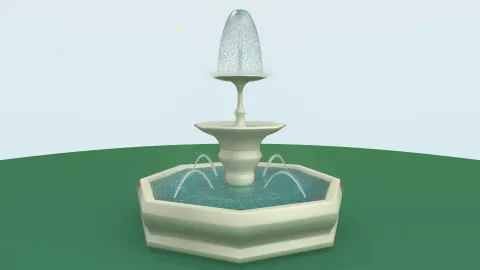
This short article displays series of fun, water-inspired simulations that bring fluid motion to life. From crystal-clear pool ripples, cascading fountains, and waves, to energetic splashes and sprays, each simulation captures a different aspect of water in motion, all powered by particle-based fluid dynamics.

Tank sloshing occurs when liquid moves inside a container because of the interaction between the liquid’s free surface and the container walls due to external forces acting on the container. In the automotive industry this is commonly observed in fuel tanks or liquid transportation systems.
Preoneers know that PreonLab is all about particles! With each release we aim to continually add new functionalities and keep improving on existing capabilities, to make our goal of developing the ultimate simulation tool a reality. Accordingly, version 6.2 will bring many additions and updates to expand on the multiphysics capabilities of PreonLab.
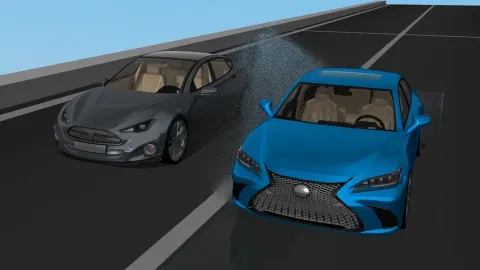
Vehicle and sensor soiling is becoming an increasingly important aspect of vehicle design. The focus is clearly shifting from pure aesthetics to challenges related to safety improvement and cost reduction.
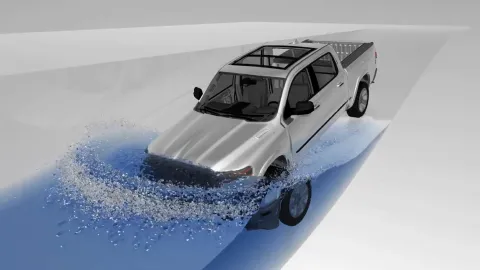
Vehicle water management is a critical component of design, which traditionally has heavily relied on costly physical testing. Whereas conventional CFD is hardly applicable due to underlying modeling complexity and extremely high computational costs, SPH technology has virtually revolutionized water management simulation.
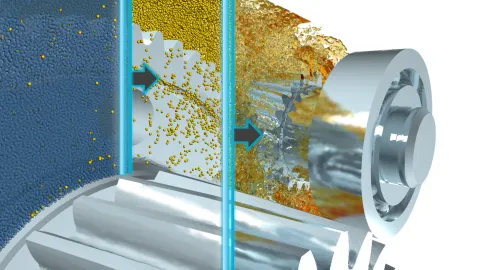
Unlock the full potential of virtual transmission development with our PreonLab Smoothed-Particle Hydrodynamics (SPH) solution in our exclusive webinar. Experience first-hand a demonstration of PreonLab's advanced modeling capabilities, validated by real-world use cases.
Preoneers rely on the fact that with every new release, PreonLab aims to enhance your simulation experience by increasing efficiency and reducing the memory footprint for simulations. We firmly hold this at the core of our vision towards developing the ultimate simulation tool.

Every Preoneer knows that with PreonLab we always strive to provide the most reliable, usable
and efficient CFD software. But what if you could get your results even faster?
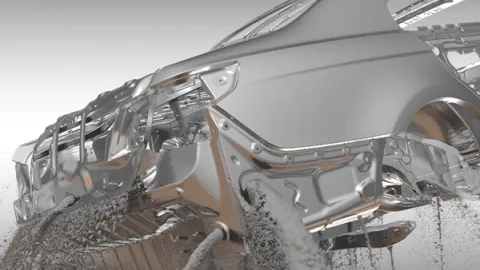
When it comes to complex production processes in the automotive industry like e-coating, using reliable CFD simulation tools to supplement expensive prototyping and physical testing has proven to be a very efficient method to optimize the design stag
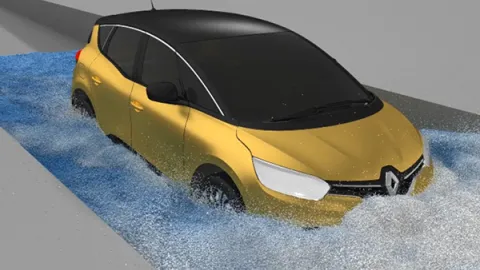
Water management is an important aspect of vehicle design. It includes everything from soiling and wading to splashing and the impact this has on the vehicle's aerodynamics. Even the vehicle's windshield wipers are part of it, as is the investigation

Vehicle water management is a challenging engineering problem to address, but the right development tool can make the process more efficient and enjoyable for the engineer.
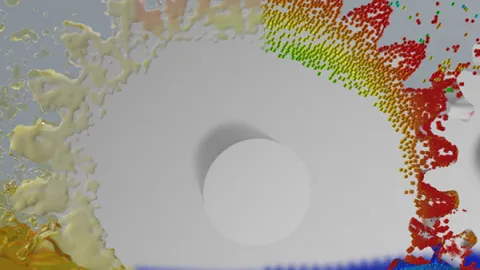
An important design task of gearbox development is the optimization of its lubrication across a wide range of operating conditions, lubricant viscosities, oil fill levels, vehicle grades and dynamic maneuvers.
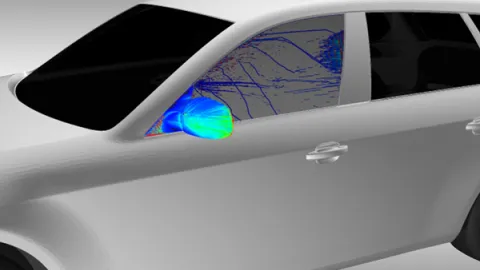
Vehicle soiling phenomena can be a major safety hazard due to obstructed driver’s visibility of the road or abnormal operation of advanced driver assistance systems (ADAS).