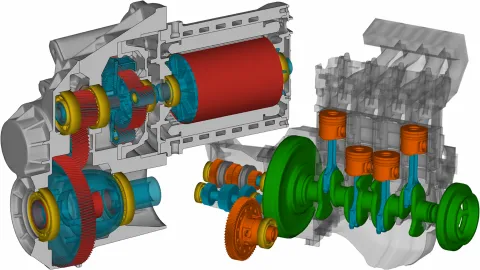
Tribology
The influence of friction, lubrication and wear under dry and lubricated conditions is essential in many areas of technology. With the help of EXCITE M you can reduce friction, optimize wear and thus increase the durability of bearings and components and reduce energy consumption.
NVH
One of EXCITE's core competencies is the calculation of structure-borne and airborne noise of powertrain units. Evaluation tools such as Operational Deflection Shape, System Modal Analysis, Numerical Transfer Path Analysis and Modal Contribution Factors provide answers to the causes and sources of excitation and vibration.
Electro-Mechanical Interaction
The e-motor is a major source of tonal noise in an e-drive. EXCITE M is capable of predicting this noise for PMSM, SCIM and EESM. The electromagnetic forces depend on operating conditions, speed, rotor misalignment and controller settings – all of which can be taken into account within the simulation software.
The influence of Pulse Width Modulation on the stator forces and rotor torque is also considered.
Durability
EXCITE M is able to accurately predict body forces and their deformation. This information is fed over time into the Finite Element (FE) and fatigue tools, which provide stress and life predictions for key components such as crankshafts.
We deliver a streamlined workflow that integrates the EXCITE M tools to obtain the dedicated inputs for the FE and fatigue tools.


AVL EXCITE™ M enables us to make reliable statements on the NVH behavior of combustion engines from the early development phase to the start of production. By jointly considering the excitation from thermodynamics, the transmission behavior of the structure, and the high prediction quality, we can make reliable statements starting from the concept phase. In addition, the analysis of the vibration behavior of the test engines is supported with validated models in the prototype development. This allows us to target our development and ensure that the acoustic goal is achieved.
– Markus Dieterich, Development Engineer Acoustics, AUDI AG

The design of piston ring packages for two-stroke and four-stroke applications is part of our daily business. New customer requirements mean that checking the design is becoming increasingly important. With AVL EXCITE™ Piston&Rings, we have found a useful addition to our existing development tools to master this task efficiently and comprehensively. The clearly structured user interface considerably simplifies model construction and conversion and the automatic generation of results reports saves us valuable time. We appreciate the reliable contact with AVL, the fast support and the customer-oriented further development of the software.
– Martin Ackermann, Global Technical Specialist Piston Systems, Kolbenschmidt Pistons Germany GmbH

The design of modern wind gears with high power density requires the use of cross-system analysis tools. The use of plain bearings in the planetary gears in particular, results in new requirements for the calculation tools themselves.
With AVL EXCITE™ M, we are able to simulate the loads on the plain bearings in planetary gears, investigate their interactions with the surrounding structures, and subsequently evaluate their applicability in planetary gearboxes for wind turbines.
– Stefan Schemmert, Head of Validation and Development Eickhoff Antriebstechnik GmbH

At WinGD, EHD simulations with the use of AVL EXCITE™ M have been carried out for almost 25 years. Everything started with a series of main bearing failures on a 96C engine where bearing layout was not based on EHD. Thanks to AVL EXCITE we were able to find appropriate solutions which were introduced as countermeasures to optimize our products. Since then, AVL EXCITE as an advanced multi-body dynamics simulation tool is an integral part of the engine development process, and the EHD calculation results correlate very well with the service experience of our bearings.
– Elzbieta Grüninger, Senior Development Expert Powertrain, Research & Development, Winterthur Gas & Diesel Ltd.

Electrified vehicles (EVs) are measured by their performance, range and cost. In addition, a compact powertrain design is desired, which has implications for thermal management.
The nearly silent operation of e-motors makes the vehicles quieter, but results in various noises and vibrations no longer being masked by the engine.

AVL is a leader in the use of simulation in vehicle development. Our simulation solution for combustion engines is used by most engine manufacturers worldwide.
With simulation, we achieve three things in powertrain development: First, we ensure durability for all components - from the crankshaft to the connecting rod and plain bearings to the entire...

Properly considering the excitation of the e-motor is essential when analyzing the NVH of e-drives. Typically, electromagnetic forces on the stator and torque on the rotor are precalculated using electromagnetic tools.

E-drives and hybrid powertrains often operate in transient conditions with changing loads and speeds, and it is essential to consider the dynamic effects of these conditions when evaluating their durability and NVH.

Modern e-axle concepts bring with them new types of design peculiarities. This can result in various disruptive effects. We will show you how special vibration phenomena can be analyzed simulatively early in the development process.

We will give you an insight into how to combine the strengths of statistical design of experiments and intelligent optimization with 3D multibody simulation using the AVL CAMEO™ and AVL EXCITE™ tools.

The elimination of the masking effect caused by the combustion engine and the trend towards high-speed e-axles make the topic of NVH a central aspect in vehicle development. We will present the current state of the art for the dynamic analysis of e-drives.

Due to the elimination of the noise-masking combustion engine, the acoustic phenomena of the transmission come to the fore in electrified vehicle concepts. We present you a workflow for calculating the map of stator tooth forces and torque fluctuations on the rotor.

Renewable energy tops the list of measures to be taken to reduce greenhouse gases in most discussions about climate change. In that respect, wind turbines show enormous potential for the future.

On the path to a clean and carbon-neutral mobility, hybrid vehicles will doubtlessly play a major role for the next decade, especially in the field of passenger cars.

Electrified powertrains are flexible in construction, highly complex and often lightweight, yet they operate at incredibly high torque loads.

The understanding of wear phenomena is relevant for several engineering fields. Basically, every application where force is transferred between directly connected and relatively moving components is prone to wear.

Legislation is pushing automotive propulsion engineers to apply advanced transmission and drivetrain technology while striving towards improving efficiency. The required measures are often negatively impacting the vehicle’s NVH behavior.

In order to satisfy the latest emission legislations, OEMs have to downsize their engines and introduce additional systems which help to reduce the footprint of an ICE vehicle.