
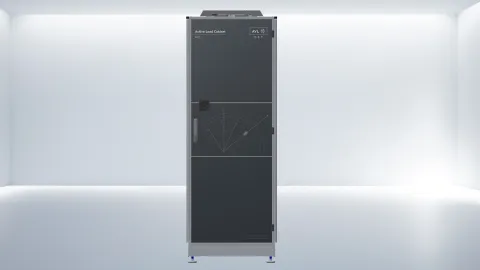
The AVL Active Load Cabinet (ALC) provides an active electrical load for functional testing of high-voltage inverter units under test (UUT). It enables hardware-focused validation at the electrical power level early in development and can be integrated into existing test environments through open communication interfaces.
By enabling functional testing under meaningful electrical load conditions, the ALC supports efficient inverter hardware validation before full hardware, software, and system integration. Engineering teams can identify hardware issues earlier, reduce troubleshooting complexity at later integration stages, and use test capacity more efficiently.

Electrical Power-Level Testing
Validate inverter hardware under active electrical load conditions early in development.
Flexible Test Conditions
Adjust resistance and inductance during operation without rebuilding the physical setup.
Earlier Failure Detection
Identify relevant hardware behavior before more complex integration stages.
The AVL Active Load Cabinet combines different operating modes to support a broad range of functional inverter hardware tests. In R-L mode, it acts as an adjustable ohmic-inductive load, with resistance and inductance parametrized during operation to adapt electrical test conditions without changing the physical setup.
Four-quadrant operation enables active-power testing in both motor and generator operation. For additional functional test requirements, the ALC can also be used as a one-phase current source, for example to calibrate internal UUT sensors or test connectors.
| Recommended min. UUT DC voltage | 300 VDC |
| Maximum UUT DC voltage | 1,000 VDC |
| Phase current, nominal | 280 or 560 ARMS |
| Phase current, maximum (overload) | 400 or 800 ARMS for 34 s (up to 900 V) |
| Fundamental frequency | Up to 1,000 Hz |
| Interfaces | EtherCAT, Ethernet, XCPonEthernet; PROFINET safety system optional |
| Rotor position sensor options | Digital encoder, active magnetic sensor and resolver sensor emulation |
Fast UUT Commissioning
Start testing quickly with a simple setup. Only four parameters need to be defined for UUT commissioning.
Dynamic Parameter Adjustment
Quickly adapt electrical test conditions during operation, reducing setup and reconfiguration effort.
Low Facility Requirements
Even at maximum UUT power, operation requires no more than a 30-kW grid connection.
Wide range of applications
thanks to additional options like one-phase current source and four-quadrant mode operation.
AVL Active Load Cabinet™ – Solution Sheet
Enabling a wide range of high-voltage functional tests for R&D applications.
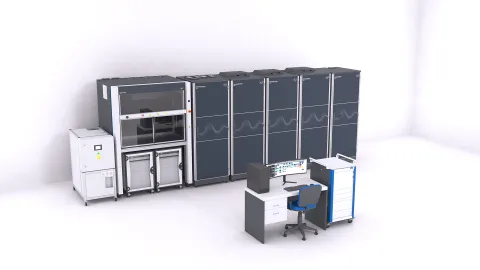
Validate inverter hardware and software independently of a physical e-motor under real electrical power conditions. AVL Inverter TS™ enables precise, repeatable e-motor emulation for earlier and more efficient inverter validation.
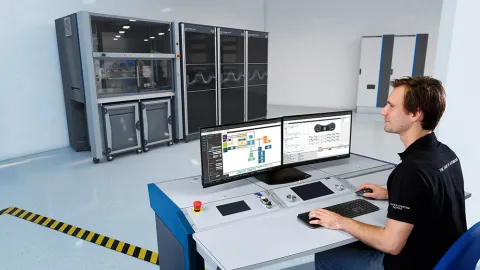
AVL PUMA 2™ Inverter is a comprehensive automation system for inverter testing, offering everything you need in one place
Modern tools are improving the historical methods used to develop and validate traction inverters. What was once a time-consuming and expensive testing process on various dynos, vehicles, and passive loads has been shortened and improved with new tools and methods.