
In response to global air pollution challenges, as highlighted by the WHO Air Quality Guideline from 2021, and the growing importance of ultrafine particle monitoring, AVL empowers environmental experts with a reliable, precise, and user-friendly solution: the AVL UltraFine Particle Monitor. Built on AVL’s proven CPC technology, it delivers essential insights into the highly impactful world of ultrafine particles. The system supports monitoring frameworks such as ACTRIS and policy implementation under Directive (EU) 2024/2881 on ambient air quality by providing high-quality data.
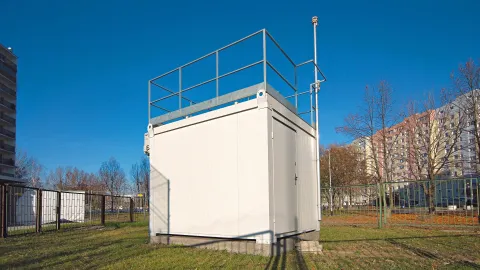
Engineered for durability and reliable performance, the AVL UltraFine Particle Monitor is based on proven condensation particle counter technology. It measures ultrafine particle number concentrations with high sensitivity and repeatability, delivering reliable particle number measurement for continuous ambient air monitoring. The instrument combines robust hardware with long-term stability, making it ideal for regulatory monitoring networks and environmental research applications.
The Condensation Particle Counter (CPC) technology detects aerosol particles down to 10 nanometers by enlarging them for optical detection. The aerosol is saturated with n-butanol vapor, and particles act as condensation nuclei as the vapor condenses onto them. The resulting droplets, now large enough to scatter light, are individually detected using a focused laser beam and photodetector system.
|
Designed as a high-performance particulate matter measurement instrument, the AVL UltraFine Particle Monitor combines reliable particle number measurement with continuous ultrafine particle monitoring for regulatory and research applications.
High Data Quality, Highest Precision
Our automated drift detection technology continuously monitors for any deviations in system performance, ensuring reliable data quality and high calibration stability.
EN 16976 Compliant.
ACTRIS-Compliant.
The UFPM meets standardized procedures for ACTRIS observatories, ensuring high-quality, consistent aerosol in-situ measurements and traceability for scientific research and environmental monitoring.
Consistent Data Flow
UFPM continuously monitors instrument status and key parameters to ensure uninterrupted data flow. In case of disruptions – like power loss or butanol depletion – it autonomously restarts, maintaining consistent long-term performance.
Straight-Forward Serviceability
The unique, patented wick design and user-friendly layout simplify operation and maintenance of the device. All parts are easily accessible, and the wick is exchanged in a minute without any tools.
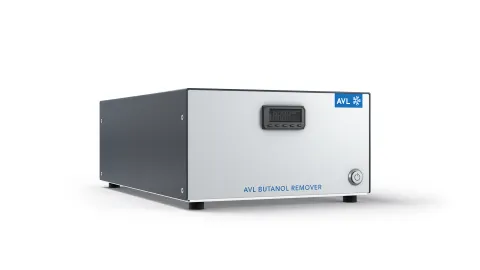
AVL Butanol Remover
The AVL Butanol Remover removes butanol vapor from CPC systems, ensuring safe and odor-free operation. By using heated catalytic conversion, it achieves a removal efficiency greater than 99.99%. The unit is lightweight, requires no consumables and is compatible with all commercial CPCs. The AVL Butanol Remover prevents interference with VOC (volatile organic compounds) measurements, making it essential for multi-pollutant monitoring stations.

AVL UFP Sampling System
The AVL UFP Sampling System enables sampling from ambient air compliant to the EN16976 standard. First, a PM10 sampling head removes biological material and large particles above 10 µm. Then, a PM2.5 cyclonic separator limits the sample to particles smaller than 2.5 µm. After that, the sample is dried using a Nafion® dryer to ensure a relative humidity below 40%, as required by EN16976. The system is modular, offering flexible installation by connecting main components with flexible tubing rather than rigid connections.
Brochure AVL UltraFine Particle Monitor™
Count on decades of experience in high-quality particle measurement
Solutionsheet AVL UltraFine Particle Monitor™
Reliability in Particle Measurement
Solution Sheet AVL Butanol Remover
Ensure Safe Exhaust Handling and Interference-Free Operation
Select how you would like to connect with us. Request your personalized quote, connect with our experts for technical insights, or ask your specific application related question. We’ll make sure your request reaches the right team quickly and efficiently.
Everything that excels at a glance: AVL highlights you shouldn't miss.

Invisible to the naked eye, yet increasingly on the radar of policymakers, ultrafine particles (UFPs) are quietly shaping the future of air quality regulations. What does current legislation in Europe look like, and is it enough to protect us from these microscopic invaders?

Discover how advanced measurement techniques are transforming air quality monitoring and why focusing on ultrafine particles is essential for protecting public health and the environment.

Discover how these tiny pollutants penetrate our bodies, impacting respiratory and cardiovascular health, and learn about the cutting-edge technologies that can help us monitor and mitigate their effects.